Czochralski Process

The Czochralski process (Cz), also known as "crystal pulling" or "pulling from the melt," is a method by which high-purity silicon (Si) is first melted and then allowed to solidify into a monocrystalline state under strictly controlled conditions. This process enables high growth rates with excellent process control. Monocrystalline silicon produced using the Czochralski process is the dominant substrate material for the semiconductor industry (e.g., wafers for integrated circuits and advanced microsystems) and is also used in photovoltaics. The process delivers high yield and consistent crystal quality, supporting large-diameter ingots and strict device specifications.


Products      Contact

Highest Standards in Crystal Growth

Perfect Silicon

The ever-increasing demands of modern microelectronics are characterized by ever higher quality requirements to enable the continuous reduction of structure sizes while maintaining cost efficiency. The aim here is to enable the optimal process for the production of “Perfect Silicon” by perfect system control in conjunction with a perfectly adapted hot zone. These conditions must be maintained and monitored throughout the entire process, placing the highest demands on the pulling, control, and feedback systems. Additional challenges arise from the need to control convection currents in the melt, gas flows in the process chamber, as well as temperature gradients at the solidification front and in the cooling crystal.

The Process

Using silicon as an example, high-purity polycrystalline silicon is melted in a quartz crucible [A] in a Czochralski single crystal pulling system under a controlled argon atmosphere. Here, a resistance heater is used. Once the temperature of the melt has stabilized near the silicon melting point at around 1,412°C, a rotating monocrystalline silicon seed is immersed into the melt [B]. A slight temperature drop triggers the crystallization of silicon on the seed crystal [C]. As the seed crystal is slowly pulled upward, a cylindrical monocrystalline silicon block forms beneath it [D]. Through precise control of the pulling speed, crystal and crucible rotation, and axial temperature gradient, a mono crystal with the lattice orientation of the seed crystal can be grown at a constant target diameter [E-F]. For comparison, graphite crucibles are used for germanium instead of quartz, and the process temperatures are adjusted accordingly to the lower melting point of about 938°C.

More Than Just Silicon

In addition to silicon, the process is also used for other material systems such as germanium. Although both materials are chemically similar (both are in group 4 of the periodic table), the process parameters for the Czochralski method differ. Due to the  lower viscosity, lower surface tension, and reduced thermal conductivity of germanium, controlling the growth process is more challenging than for silicon, and the crystal pulling speed is lower. Germanium is typically used in electronics as a semiconductor component and as a window or lens material in IR optics. High-purity germanium single crystals are also used as radiation detectors in nuclear medicine or nuclear technology. The Czochralski process is also used for the growth of optical (laser) crystals and, less frequently today, for sapphire.

Next
Close-up showing a large crystal inside a reactor, with the conical lid visible above
Graphic showing the sequential steps of the Czochralski process for growing high‑purity monocrystalline silicon
Circular melt in a crucible with a crystal growth seed rod centered above, viewed from above

Relevant industries

The growth of monocrystalline crystals has since become indispensable in a whole range of applications. For the photovoltaic and the semiconductor industry for logic and memory as well as power electronics applications, the regular lattice structure of ultra-pure monocrystalline crystals ensures efficient production that is viable for future requirements.

Semiconductor

Cz-grown silicon wafers are the basic substrates for logic, memory, analog/mixed-signal, and power management ICs. Increasingly, different crystal orientations are being grown for high-tech applications.

More about the industry

Power Electronics

Czochralski-grown (Cz) silicon wafers are widely used as substrates for high- and medium-voltage devices such as IGBTs, MOSFETs, diodes, and thyristors, with both 200 mm and 300 mm diameters utilized. Increasingly, different crystal orientations are produced to meet the requirements of advanced applications.

Photovoltaics

Cz-grown silicon wafers are ideal for high-efficiency solar cells due to their uniform crystal structure and low defect density. Compared to the semiconductor technology, higher pulling speeds are used here to increase output.

Energy

The Czochralski (Cz) process is the leading technology for producing large, high‑quality monocrystalline silicon ingots used in high‑efficiency solar cells. With precisely controlled thermal conditions and stable pulling dynamics, the Czochralski process ensures excellent material purity, homogeneity, and crystal structure. The silicon wafers manufactured from these ingots serve, among other applications, as the base material for the production of solar cells. These solar cells are then used in the manufacturing of PV modules, which power photovoltaic systems.

Beyond power electronics, silicon semiconductor chips are used throughout the energy sector in intelligent electricity meters, sensors, automation and communication systems, as well as measurement and monitoring devices. They enable precise data acquisition, reliable system monitoring, and efficient control of energy infrastructure. Thanks to the high level of integration, reliability, and cost efficiency of silicon, these chips provide optimal conditions for modern energy management.

More about the industry

Characterization

  • Precision: Precisely manufactured drive units enable reproducible process control and the production of crystals of the highest possible quality.
  • Automation: Fully automatic process control as well as automated lifting and swiveling operations. The degree of automation in all production steps is continuously being expanded.
  • Safety: Comprehensive safety concepts with multiple redundant protection systems, continuous monitoring of all critical process parameters, and automatic emergency shutdowns ensure maximum operational safety. This enables reliable and safe operation even in the most demanding production environments and minimizes the risk of downtime or damage.
  • Customization: With decades of development expertise and modular components, PVA TePla is ideally positioned to deliver optimal solutions for customer-specific requirements.
  • Support & Service: Spare parts supply, system adaptation, and optimization are ensured through direct contact with PVA TePla experts.

A Foundation for Digital Transformation

What began with the accidental dipping of a pen into molten tin has evolved into the most important crystal growing process in microelectronics and photovoltaics, forming the basis for the rapid digital transformation of industry, science, and society. Named after Jan Czochralski, the Czochralski process has matured for industrial production and is currently used to produce silicon crystals with diameters of up to 300 mm (even larger diameters are possible for silicon components) and weights of up to 1,000 kg. For this purpose, high-purity silicon is melted in a quartz crucible at approximately 1,412°C, and the monocrystalline silicon ingot is pulled from the melt by controlled solidification using a seed crystal.

PVA TePla operates its own development laboratory, where the latest topics in system and process development are researched, applied, and tested in close cooperation with research institutes. Every newly developed system type and all associated accessories are subjected to intensive testing. This applies not only to Czochralski technology development but to the entire PVA TePla product portfolio.

Technical Support

Our technical support in the field of Czochralski technology includes comprehensive process support for silicon and germanium processes as well as other materials. For silicon, we offer support for Semi-Si and PV-Si processes with ingot diameters of up to 12 inches. In the area of germanium, we support the growth of monocrystalline Ge ingots with individually tailored diameters. In addition, we offer joint process development for other materials. Our support is flexible – both on-site and remote, always in close coordination with our customers. We offer simulations of crystal growth processes and provide hot zone designs based on proven PVA processes for silicon and germanium in various sizes. With our many years of experience in semiconductors and photovoltaics, we support our customers in the development and optimization of their own production processes.

Sustainable Production Made in Europe

For the production of standard and customer‑specific pressure vessels, components, and vacuum chambers, we operate our own manufacturing facility in Europe. It is entirely powered without the use of fossil fuels, fully aligning with our sustainability objectives.

Key advantages at a glance

  • Fast delivery times: Greater independence from external suppliers
  • Flexible customization: Short‑notice design changes can be implemented immediately.
  • Reliable material availability: Constant access to high‑quality materials thanks to long‑standing local partnerships.
  • Highest processing quality incl. standards: Performing welding operations in‑house allows direct monitoring of joint conformity, which is essential for meeting standards such as UNI EN ISO 3834.
  • Top‑tier standards: Naturally, our facility meets our stringent requirements for quality, safety, and sustainability.
Next
Czochralski systems
Close-up of crystal growth vessel openings with metal flanges and condensation on the surface

The Czochralski systems at a glance

SC-Line

SC-Line

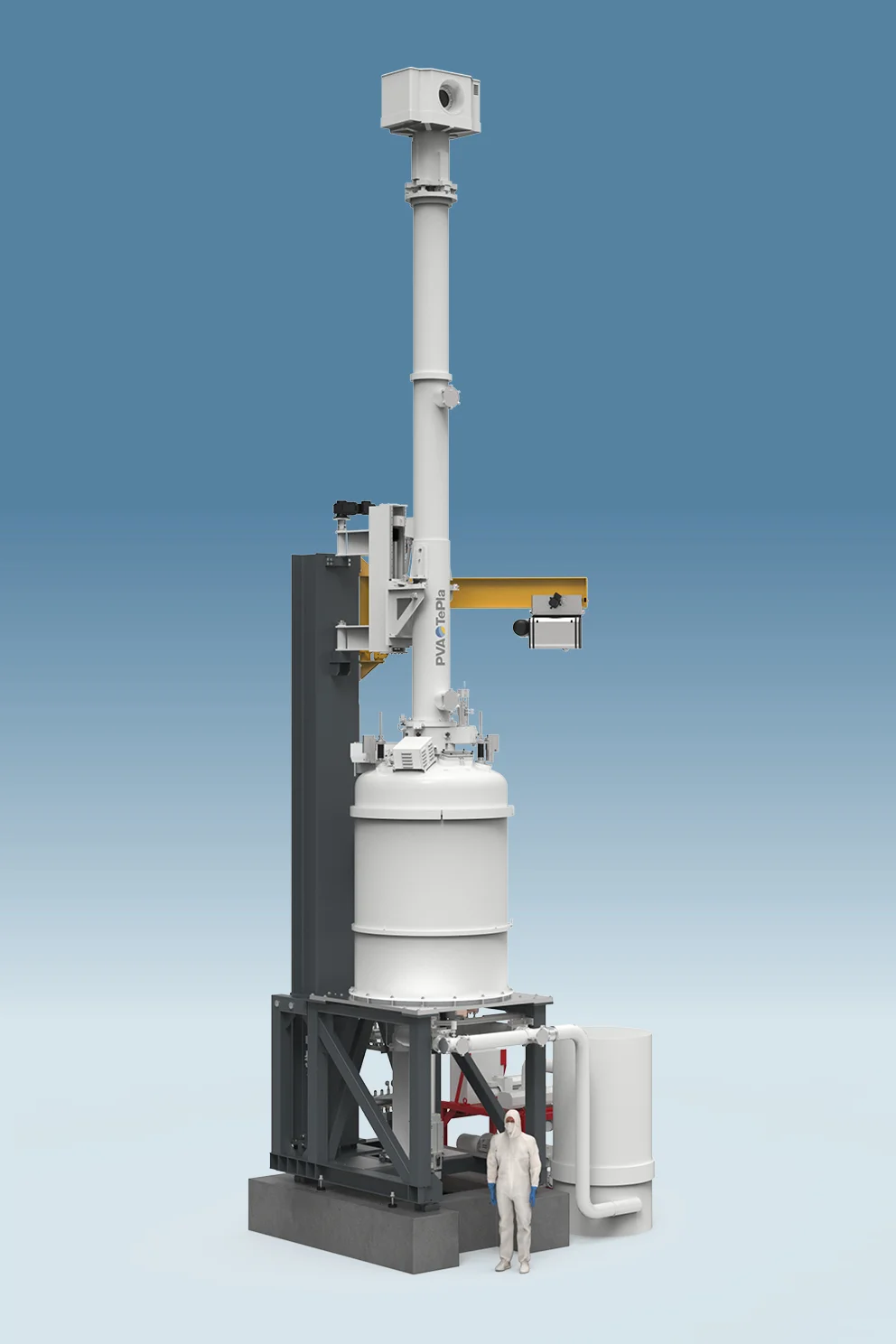
Within the SC-Line, PVA offers the most advanced Czochralski system on the market with a wide range of configuration options. Various chamber  designs (3- or 5-part) and different levels of automation can be selected. The SC-Line offers a compact, flexibly configurable Czochralski system for the production of monocrystalline silicon ingots for the semiconductor industry, enabling the production of ingots with diameters from 200 to 300 mm (8 to 12 inches) in large quantities. 

More about the system
CGS1218

CGS1218

The CGS 1218 is a high-performance crystal pulling system for the semiconductor industry, designed for the production of high-purity silicon ingots with excellent reproducibility and yield. The system is available with either a shaft or cable drive for crystals and offers precise, highly linear control of pulling speed and rotation for stable diameter control and consistent crystal quality. The five-part process chamber accommodates 32- to 36-inch hot zones and is prepared for active crystal cooling and magnet integration, ensuring future-proof production capabilities.
With this system, crystal diameters of up to 18 inches are possible.

More about the system

Interested in crystal growing systems?

Get in touch